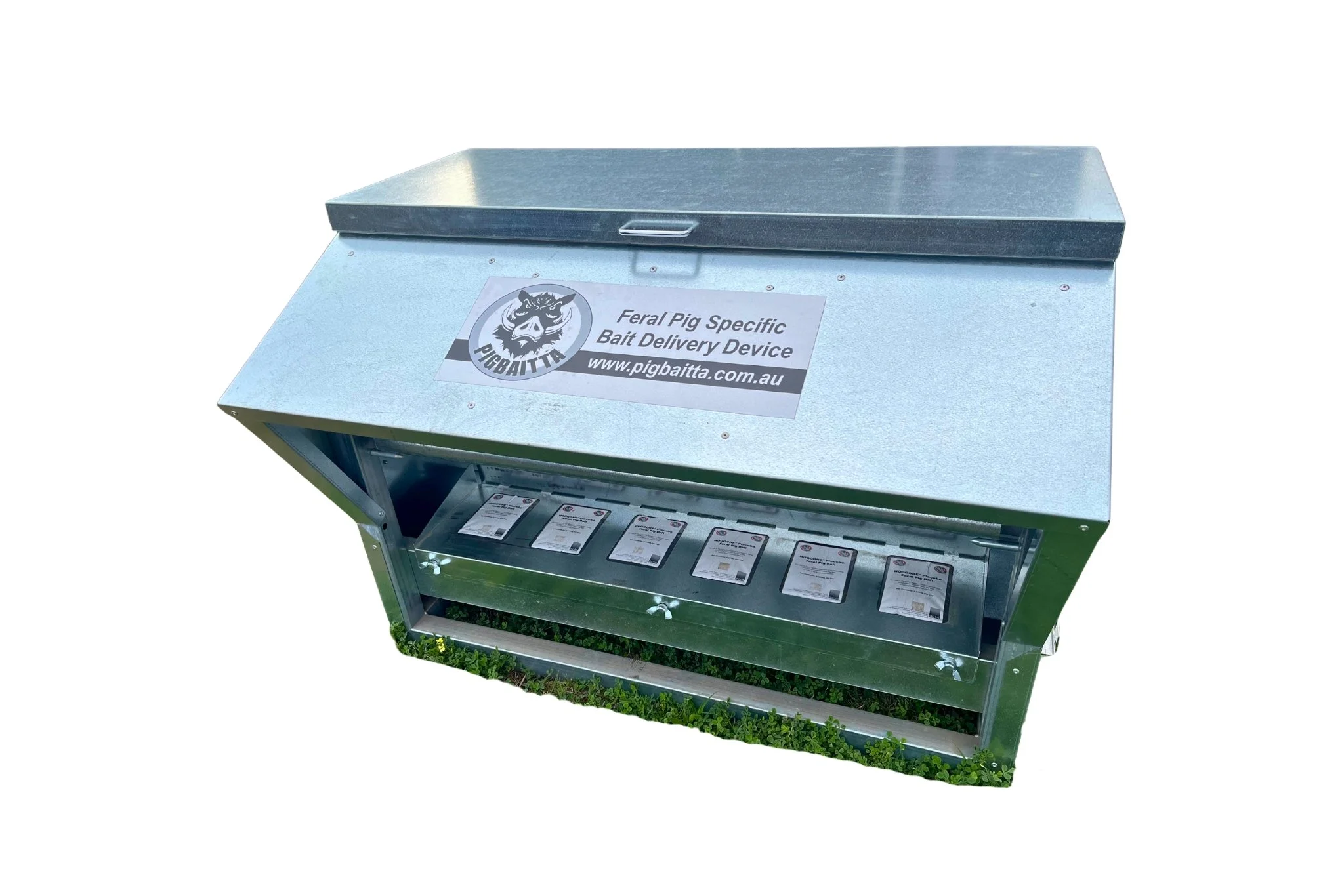
Conducting a PIGOUT® programme

Ground placement of baits with pre-feeding

Identify areas of feral pig activity through historical knowledge and observation of fresh signs such as wallows, faeces, rooting, tracks, watering point activity, sightings and surveys.

Establish bait stations in these areas by placing small piles (0.5kg) of grain or several un-poisoned PIGOUT® Pre-Feed baits every 50 to 100m.

Earth or sand pads around bait stations should be swept to allow the prints of animals approaching and consuming bait material to be determined.

Check the bait stations regularly over several days for evidence confirming pig activity and replace ‘free-feed’ baits or grain with new material at sites where free-feed was taken.

Gradually reduce the number of feeding points to encourage pigs to feed from a central free-feeding area.

At the end of the free-feed period, place poisoned PIGOUT® baits in clusters at each active bait station. Monitor uptake daily and replace taken baits until bait take stops (generally day 2 or 3).

The number of baits should reflect the estimated number of feral pigs present, with enough baits offered to ensure that each pig has access to at least one or two baits.

Where possible, recover any uneaten poisoned baits three days after placement or after bait-take ceases.

PIGOUT Feeding Sequence - Bait dispersal

PIGOUT Feeding Sequence Pigs arive to feed

PIGOUT Feeding Sequence - Still feeding

PIGOUT Feeding Sequence - Still feeding

PIGOUT Feeding Sequence - Baits alomost consumed

PIGOUT Feeding Sequence - Pigs gone -- carcasses collected later

Pigs feeding on PIGOUT® baits: time lapse series. Most baits are consumed and pig mob reduced in size.

Efficacy of PIGOUT® Pig Baits

Extensive trials have been conducted across numerous land types and conditions that have clearly demonstrated the effectiveness of PIGOUT® Feral Pig Bait.

In this sequence of photographs taken with high-tech remote sensing cameras, a mob of pigs encounters a cluster of toxic PIGOUT® baits.

The pigs find and consume all but a few of the baits over a period of a couple of hours.

Feral pigs have been shown to self-regulate their intake of baits and ‘1080’ depending on their body size and speed of bait consumption.

This means if a baiting program is to be successful, it is better to place more baits than the estimated number of pigs rather than fewer baits.

This applies to any type of bait including grain and meat, and may explain lower than expected rates of success in conventional baiting programs.

In this trial, carcasses of 80% of the pig population were recovered the next morning in close proximity to the bait station.

Aerial baiting

Inspect area to determine the location and indicative mob size of feral pigs present.

The number of baits distributed should reflect the overall density of feral pigs, and the area over which baiting is to occur.

Deploy PIGOUT® baits at a rate of 10 to 40 baits per km2 in clusters of 5 to 10 baits depending on anticipated feral pig mob size (greater mob size = greater cluster size).

Baiting clusters should either be dispensed along defined grid lines throughout areas where feral pigs are known to be active, or selectively to areas of known high local pig density such as around waterholes.

The latter practice is preferred as it will enable multiple baits to be found by a mob of feral pigs.

Aerial free-feeding

Free-feeding is not normally conducted in aerial baiting campaigns but there is no restriction on this being done using un-poisoned PIGOUT® Free-Feed baits.

Free-feed the area using un-poisoned PIGOUT® Free-Feed baits once or twice during the week prior to poison bait deployment to encourage maximum uptake of the poisoned baits by feral pigs.

The key to successful free-feeding is using accurate GPS equipment to ensure the free-feed drops are in exactly the same area as the poison bait drops.

Dose and Bait Numbers

The dose of ‘1080’ in PIGOUT® baits is 72mg/bait. This is much higher than the dose required in predator baits used for the control of foxes (3mg/bait) and wild dogs (6mg/bait).

The pig bait dose provides sufficient poison to kill the average sized pig in the shortest time from a single bait, and the presentation of the toxin in an inner core seeks to minimise the risk to non-target animals.

Some pigs require more than one bait due to their large size, or because of the wide individual variation in tolerance between pigs to 1080 poison.

Pigs will readily eat several baits if offered so it is best to provide more baits than the estimated number of pigs present in order to maximise the opportunity for all pigs in a group to obtain one or more baits.

Feral pigs will not always take baits whether PIGOUT®, meat or grain. This is normally related to the movements of mobs, the availability of other natural foods and the level of wariness, often a function of previous persecution. Should feral pigs fail to take bait, whether free-feed or poisoned, postpone the baiting program to a more appropriate time.

Restrictions to access and use of PIGOUT® baits

1080 is a Schedule 7 Restricted poison under the Standard for the Uniform Scheduling of Drugs and Poisons (SUSDP) and the Agricultural and Veterinary Chemicals Code Regulations, and requires special precautions in manufacture, handling, labelling, storage and use.

The details on the PIGOUT® label are extensively reviewed and approved by the APVMA and its associated review agencies. Baiting feral pigs must only occur under the conditions set out on the product label or under special permits issued by the APVMA.

See the State 1080 Regulations page on this site for more specific details.

Protection of native fauna, stock, working dogs and pets

PIGOUT® baits have been shown to be highly target specific and have several features to help minimise the risks of 1080 poisoning during feral pig control programs to non-target animals.

The poison in PIGOUT® is localised to the centre of each bait in a special core, and the matrix is coloured, flavoured and structured to minimise uptake by most non-target herbivores, carnivores, birds and stock.

Nevertheless, no control operation is risk free and in addition to following the instructions on the label, the following measures should be adopted to further minimise risks to all non-target animals:

Baiting must not occur where wildlife or stock could be harmed.

Distance restrictions

1080 baiting is not permitted in urban or residential areas where potential harm to domestic animals or people may occur.

There are various state and territory regulations as to where poison baiting can occur in relation to various features such as houses, roads, water courses and property boundaries.

Baits must be placed at least 150m from a dwelling; 20m from permanent or flowing water bodies; 5m from boundary fences; and 5m from the edge of formed public roadways; or as specified by State/Territory.

Notification and signage requirements

Neighbours must be notified to allow them to take appropriate action. The notification must advise that steps (e.g. restraint, muzzling) need to be taken to ensure that domestic dogs do not gain access to 1080 baits or poisoned animals.

The notification must specify the dates between which baiting will occur. This notification should be in writing and should be given to all adjoining landholders at least 72 hours in advance except where alternative communication arrangements have been made that meet State/Territory requirements and overall safety criteria.

A record of the notifications must be kept. Baiting must commence within ten days of notification or else another three days notice of intent to lay baits is required.

Users must ensure that signs are put up immediately before 1080 poisoning operations commence on the property and are placed according to requirements specified by the relevant State/Territory. See the State 1080 Regulations page on this site for more specific details.

Signs must be maintained for at least 4 weeks after the authorised period of bait lay has expired or after all untaken baits have been collected.


Animal Control Technologies
46-50 Freight Drive
Somerton, Victoria, 3062
Australia
Telephone +61 3 9308 9688
Fax +61 3 9308 9622

E-mail: enquiries@animalcontrol.com.au